On February 11, 2016, the University of Ottawa’s Faculty of Law will be hosting Anne Giardini to talk about The Expanding Ethical and Legal Responsibilities of Lawyers and Corporate Directors. The poster below has more details.

On February 11, 2016, the University of Ottawa’s Faculty of Law will be hosting Anne Giardini to talk about The Expanding Ethical and Legal Responsibilities of Lawyers and Corporate Directors. The poster below has more details.
MESSAGE EN FRANÇAIS À LA SUITE
The following is a message from Gavin Hume:
Dear Colleagues,
I am writing to announce that the Federation of Law Societies of Canada has launched the Interactive Model Code of Professional Conduct, an online tool that links the provisions in the Federation’s Model Code to the matching or related rules of professional conduct in every law society in Canada.
This interactive tool will allow mobile lawyers, law society staff and leaders, academic researchers and others to quickly and easily find the enforceable rules in every Canadian jurisdiction using the national Model Code as the central reference point. Users will be able to isolate specific sections of the Federation’s Model Code and view the corresponding code of conduct of another jurisdiction.
The Federation’s Model Code was developed to harmonize as much as possible the ethical rules governing lawyers across Canada. It has now been implemented by ten Canadian law societies, is reflected in the Barreau du Quebec’s new Code of Professional Conduct and is under review in the remaining jurisdictions.
The Interactive Model Code of Professional Conduct is available on the Federation’s web site (www.flsc.ca) and can be accessed through a permanent link at: http://flsc.ca/interactivecode.
The Federation of Law Societies of Canada is the national coordinating body of the 14 law societies mandated by provincial and territorial law to regulate Canada’s 100,000 lawyers, Quebec’s 4,000 notaries and Ontario’s 7,200 licensed paralegals in the public interest. It is a leading voice on issues of national and international importance relating to the administration of justice and the rule of the law.
Sincerely,
Gavin Hume, Q.C., Chair, Standing Committee on the Model Code of Professional Conduct,
Federation of Law Societies of Canada
*******************
Ce qui suit est un message de Gavin Hume :
Chères/chers collègues,
Je vous écris pour vous annoncer que la Fédération des ordres professionnels de juristes du Canada a lancé le Code type de déontologie professionnelle interactif, un outil en ligne qui fait le pont entre les dispositions du Code type de la Fédération et les règles de déontologie professionnelle reliées ou correspondantes parmi tous les ordres professionnels de juristes au Canada.
Cet outil interactif permettra aux avocats en déplacement, au personnel et aux dirigeants des ordres professionnels de juristes, aux chercheurs universitaires et à d’autres intéressés de trouver les règles de conduite facilement et rapidement dans toutes les juridictions canadiennes en utilisant le code type national en tant que point de référence central. Les utilisateurs pourront isoler des sections spécifiques du Code type de la Fédération et visualiser le code de déontologie dans chaque jurisdiction.
Le Code type de la Fédération fut conçu pour harmoniser les règles de déontologie gouvernant les avocats à travers le Canada du mieux possible. Celui-ci vient d’être mis en œuvre par dix ordres professionnels de juristes au Canada, est reflété dans le nouveau code de déontologie professionnelle du Barreau du Québec et fait l’objet d’examen dans les juridictions restantes.
Le Code type de déontologie professionnelle interactif est disponible sur le site Web de la fédération (http://flsc.ca/fr/) et l’accès est disponible grâce au lien permanent suivant: http://flsc.ca/fr/codeinteractif/.
La Fédération des ordres professionnels de juristes du Canada est l’organisme coordonnateur national des 14 ordres professionnels de juristes qui, en vertu de la loi de leur province ou territoire, ont le mandat de réglementer les 100 000 avocats du Canada, les 4 000 notaires du Québec et les 7 200 parajuristes autorisés de l’Ontario dans l’intérêt du public. Elle joue un rôle de premier plan dans des dossiers d’intérêt national et international qui concernent l’administration de la justice et la primauté du droit.
Très sincèrement à vous,
Gavin Hume, c.r.
Président, Comité permanent sur le Code type de déontologie professionnelle de la Fédération
*******************
Daphne Keevil Harrold
Policy Counsel / Conseillère en matière de politiques
Federation of Law Societies of Canada / Fédération des ordres professionnels de juristes du Canada
World Exchange Plaza
1810 – 45 rue O’Connor Street
Ottawa, Ontario, Canada K1P 1A4
dkeevil@flsc.ca
t. 613.783.7393
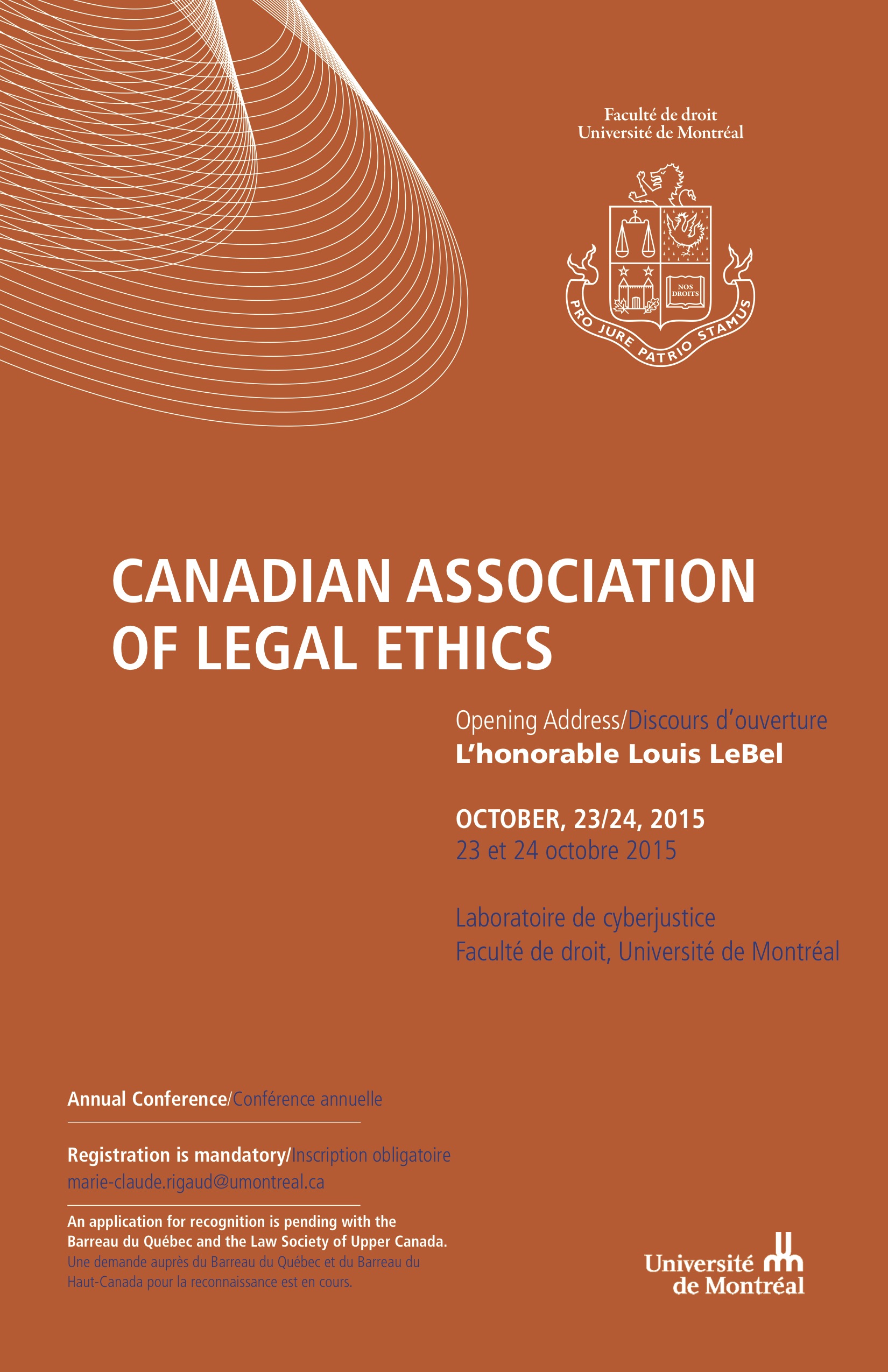
The 2015 CALE conference will be hosted by the Université de Montréal, Faculté de droit/Faculty of Law on October 22 – 24, 2015. CALE 2015 Conference 2015-10-12
DirectionsCALE Conference 2015 Directions
Published in the Alberta Law Review, Vol 52, No 3
Noel Semple, Assistant Professor, University of Windsor Faculty of Law, Canada
Through a comparative study of English-speaking jurisdictions, this book seeks to illuminate the policy choices involved in legal services regulation as well as the important consequences of those choices. Regulation can protect the interests of clients and the public, and reinforce the rule of law. On the other hand, legal services regulation can also undermine access to justice and suppress innovation, while failing to accomplish any of its lofty ambitions. The book seeks a path forward to increasing regulation’s benefits and reducing its burdens for clients and for the public. It proposes a client-centric approach to enhance access to justice and service quality, while revitalizing legal professionalism, self-regulation, and independence.
Posted to SLAW June 10, 2015
In many ways, Canadian law societies are now more transparent institutions than ever before. The Law Society of Upper Canada, for example, has adopted innovations like live webcasts of Convocation meetings, online Annual Reports and a frequently used Twitter account which allow for easier access and greater insight into what goes on at Osgoode Hall and why. And, of course, for those interested in what happens to lawyers “gone bad”, there is free public access to discipline-related decisions on CanLII.
Disciplinary decisions seem to be, indeed, one of the things that lawyers and the public are most interested in. In recent years, several high profile cases – including the ongoing civility case involving newly elected Bencher Joseph Groia, and the now-dismissed conflict of interest allegations brought against former Hollinger lawyers – have received considerable attention. Just in the past few months, the proceedings against a Toronto lawyer who received a five-month suspension after admitting to professional misconduct in representing refugee claimants has received significant media attention (see, here, here, and here).
Posted to SLAW on April 1, 2015
For roughly 30 years, some Canadian lawyers have been engaging in a practice that other Canadian lawyers have vociferously criticized as “extortion with letterhead,” “bullying and intimidation”, a “predatory practice” and “an example of legal strong-arming.” Members of the public have also chimed in, characterizing the practice as “morally wrong” and “like being stabbed in the back”.
The practice at issue is the sending of shoplifting demand letters. In short, this involves lawyers acting for retailers sending letters to alleged shoplifters and/or their parents demanding the payment of money.
To take one example reported in the media, in 2004, one mother received a letter from a lawyer for a retailer four months after her daughter was caught trying to steal lip gloss. The letter “demand[ed] [the mother] pay $379 to help defray the cost of shoplifting or face the consequences, threatening a civil lawsuit for as much as $900.” To take another, more recent, example, in 2012, an eighteen year old paid $610 in response to a demand letter after she was caught stealing just over six dollars in cosmetics.
The Faculty of Law at Queen’s University has established an Annual Lecture series in Legal Ethics and Professionalism. The program enjoys the generous sponsorship of McCarthy Tétrault LLP. This year’s Annual Lecture is the 1st of a series that will highlight the importance of legal ethics and professionalism in law and amongst all legal professionals.
Our inaugural speaker, for the 2015 Annual Lecture, is former Ontario Court of Appeal Justice, the Honourable Stephen Goudge, Q.C.. On Monday January 26th, at 1 pm, Justice Goudge will speak at Queen’s Law about the intersection between legal ethics and professionalism and the respective roles of the judiciary, lawyers and others, including Law Societies. The event has been accredited for 1.5 hours of professionalism CPD by the Law Society of Upper Canada.
Alice Woolley posted to SLAW on December 29, 2014
Being a competent lawyer means knowing your own limits. Lawyers representing clients in cases for which they do not have the necessary knowledge and skills risk liability in negligence, being found to have provided ineffective assistance of counsel (in a criminal case) and violating the obligations of the codes governing their conduct. Those codes define the competent lawyer as “recognizing limitations in one’s ability to handle a matter of some aspect of it and taking steps accordingly to ensure the client is appropriately served” (FLS Model Code, Rule 3.1-1(h)). They further state that a lawyer ought not to take on a matter for which she is not competent and must recognize “a task for which the lawyer lacks competence” (Rule 3.1-2, Commentaries 5 and 6).
How difficult can this be? Quite, according to some recent media reports. While the facts as reported are not sufficient to support the conclusion that the lawyers involved acted improperly, they do at least raise the question: given the apparent disconnect between their expertise and their clients’ circumstances, why were these lawyers acting? And what lessons might we be able to draw to allow lawyers to appreciate when folding ‘em is wiser than holding ‘em?
By Elaine Craig and posted to SSRN October, 2014
Abstract:
Online advertising has become a primary source of information about legal services. This trend towards web-based marketing of legal services poses new challenges to the regulation of the legal profession. Challenges which, to date, have not been fully met. It also creates a new source of data for researchers studying aspects of the legal profession such as legal ethics, lawyers’ perspectives and strategies, and legal discourse.
The objective of this study is to examine the most prominent websites in Canada that advertise legal representation for individuals accused of sexual offences. The study of these websites yielded two types of observations regarding the commercial expression engaged in by this subset of the criminal defence bar. The first pertains to the parameters of ethical advertising by criminal defence lawyers who practice sexual assault law. A significant subset of lawyers who advertise legal representation services to individuals accused of sexual offences engage in commercial expression that appears to be inconsistent with the limits and guidelines specified in their professional codes of conduct. The study produced a second observation. Examination of these websites offers a window into the narratives about sexual assault that some defence lawyers construct for their clients, and perhaps also the perspectives about sexual assault held by defence lawyers themselves.
 Canadian Association for Legal Ethics / Association canadienne pour l’éthique juridique